Where in Journal Articles Does a Literature Review Typically Appear?
What is a Literature Review
A literature review is an objective, concise, critical summary of published research literature relevant to a topic being researched in an article.
A literature review does Not:
A literature review does non simply reference and list all of the material y'all take cited in your newspaper.
- Presenting material that is non directly relevant to your study will distract and frustrate the reader and make them lose sight of the purpose of your study.
- Starting a literature review with "A number of scholars have studied the relationship between X and Y" and but listing who has studied the topic and what each scholar ended is not going to strengthen your paper.
A good literature review DOES:
- Present a brief typology that orders articles and books into groups to assist readers focus on unresolved debates, inconsistencies, tensions, and new questions almost a research topic.
- Summarize the nigh relevant and of import aspects of the scientific literature related to your area of enquiry
- Synthesize what has been done in this expanse of research and past whom, highlight what previous research indicates nearly a topic, and place potential gaps and areas of disagreement in the field
- Requite the reader an understanding of the background of the field and prove which studies are important—and highlight errors in previous studies
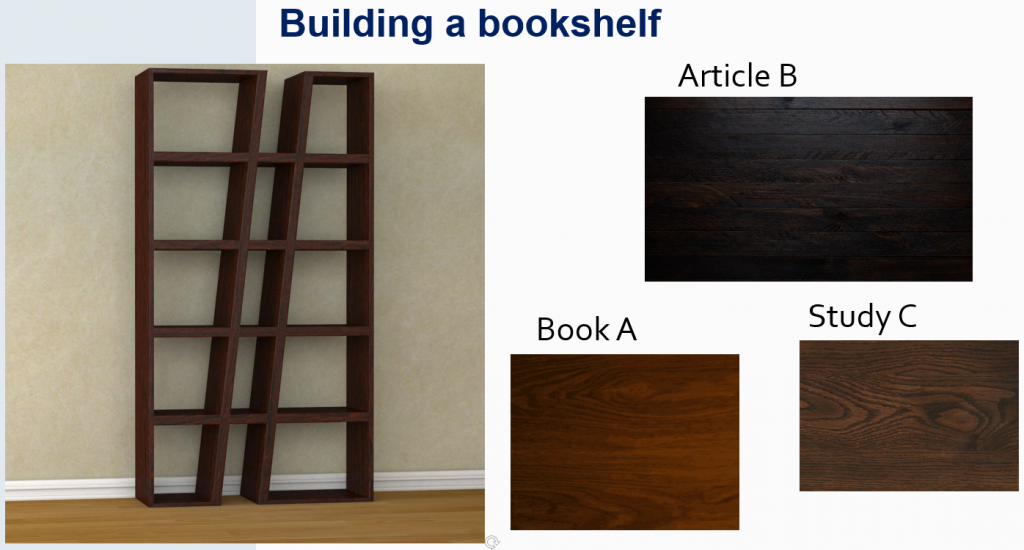
Building Your Literature Review Bookshelf
1 fashion to excogitate of a literature review is to think about writing information technology as you would build a bookshelf. You don't need to cut each slice by yourself from scratch. Rather, you can take the pieces that other researchers accept cut out and put them together to build a framework on which to hang your own "books"—that is, your own study methods, results, and conclusions.
What Makes a Good Literature Review?
The contents of a literature review are determined by many factors, including its precise purpose in the article, the degree of consensus with a given theory or tension between competing theories, the length of the article, the number of previous studies existing in the given field, etc. The following are some of the most important elements that a literature review provides.
- A historical groundwork for your enquiry: Analyze what has been written about your field of research to highlight what is new and significant in your study—or how the analysis itself contributes to the understanding of this field, even in a small way. Providing a historical background likewise demonstrates to other researchers and journal editors your competency in discussing theoretical concepts. You should likewise make sure to empathise how to paraphrase scientific literature to avoid plagiarism in your work.
- The electric current context in which your research is situated: Hash out central (or peripheral) questions, issues, and debates in the field. Because a field is constantly being updated past new work, y'all tin show where your research fits into this context and explain developments and trends in research.
- A discussion of relevant theories and concepts that provide the foundation for your research: For example, if y'all are researching the relationship betwixt ecological environments and human populations, provide models and theories that focus on specific aspects of this connection to contextualize your written report. If your report asks a question apropos sustainability, mention a theory or model that underpins this concept. If information technology concerns invasive species, choose material that is focused in this direction.
- A definition of the relevant terminology: In the natural sciences, the meaning of terms is relatively straightforward and consistent. But if yous present a term that is obscure or context-specific, you should ascertain the meaning of the term in the Introduction section (if you are introducing a written report) or in the summary of the literature being reviewed.
- A description of related inquiry that shows how your work expands or challenges earlier studies or fills in gaps in previous piece of work: Y'all can utilise your literature review as evidence of what works, what doesn't, and what is missing in the field.
- Supporting evidence for a practical trouble or consequence your inquiry is addressing that demonstrates its importance: Referencing related research establishes your area of enquiry every bit reputable and shows you are building upon previous work that other researchers have deemed meaning.
Types of Literature Reviews
Literature reviews can differ in structure, length, and amount and latitude of content included. They can range from the selective (a very narrow area of inquiry or simply a unmarried work) to the comprehensive (a larger amount or range of works). They can also be part of a larger piece of work or stand on their ain.
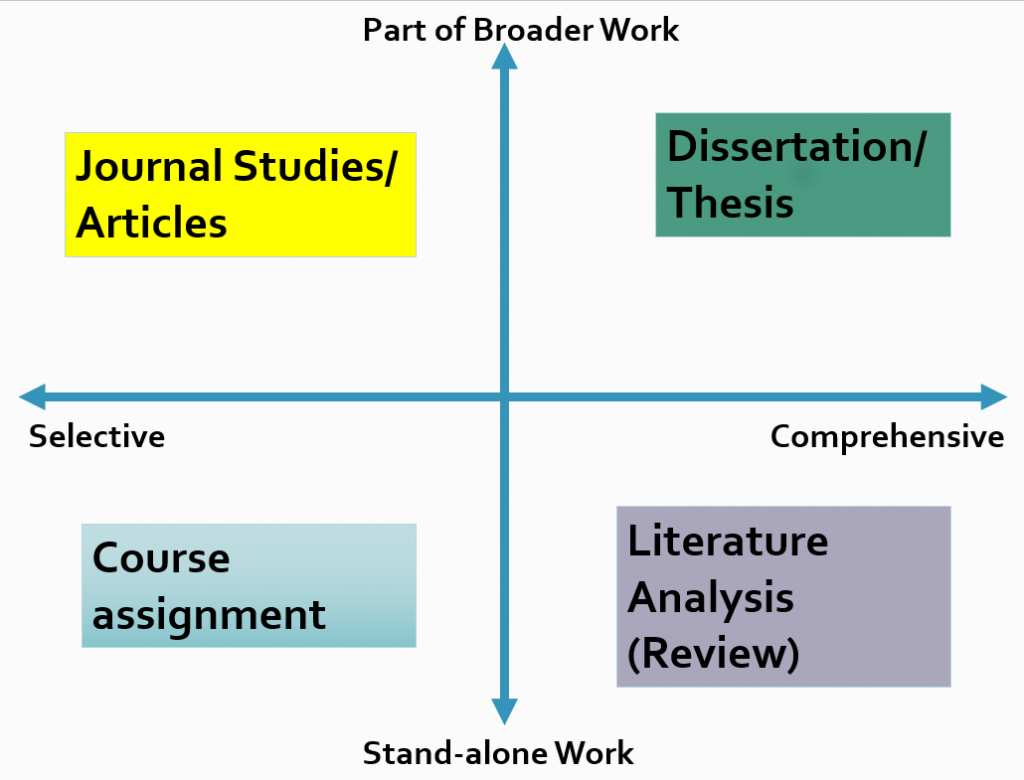
- A course assignment is an example of a selective, stand up-alone piece of work. It focuses on a small-scale segment of the literature on a topic and makes up an unabridged work on its own.
- The literature review in a dissertation or thesis is both comprehensive and helps make up a larger piece of work.
- A majority of journal articles start with a selective literature review to provide context for the inquiry reported in the study; such a literature review is usually included in the Introduction section (simply it can also follow the presentation of the results in the Word department).
- Some literature reviews are both comprehensive and stand every bit a separate work—in this case, the unabridged article analyzes the literature on a given topic.
Type of Literature Reviews Found in Journals
The 2 types of literature reviews commonly found in journals are those introducing research articles (studies and surveys) and stand-solitary literature analyses. They can differ in their scope, length, and specific purpose.
Literature reviews introducing research articles
The literature review found at the beginning of a journal article is used to introduce enquiry related to the specific study and is found in the Introduction section, ordinarily almost the end. It is shorter than a stand up-lonely review because information technology must exist limited to very specific studies and theories that are directly relevant to the current study. Its purpose is to set research precedence and provide support for the study's theory, methods, results, and/or conclusions. Not all research articles contain an explicit review of the literature, simply nearly do, whether it is a discrete section or duplicate from the rest of the Introduction.
How to structure a literature review for an commodity
When writing a literature review as function of an introduction to a study, simply follow the structure of the Introduction and move from the general to the specific—presenting the broadest background information about a topic showtime and then moving to specific studies that back up your rationale, finally leading to your hypothesis argument. Such a literature review is often indistinguishable from the Introduction itself—the literature is INTRODUCING the background and defining the gaps your study aims to fill.
The stand-lonely literature review
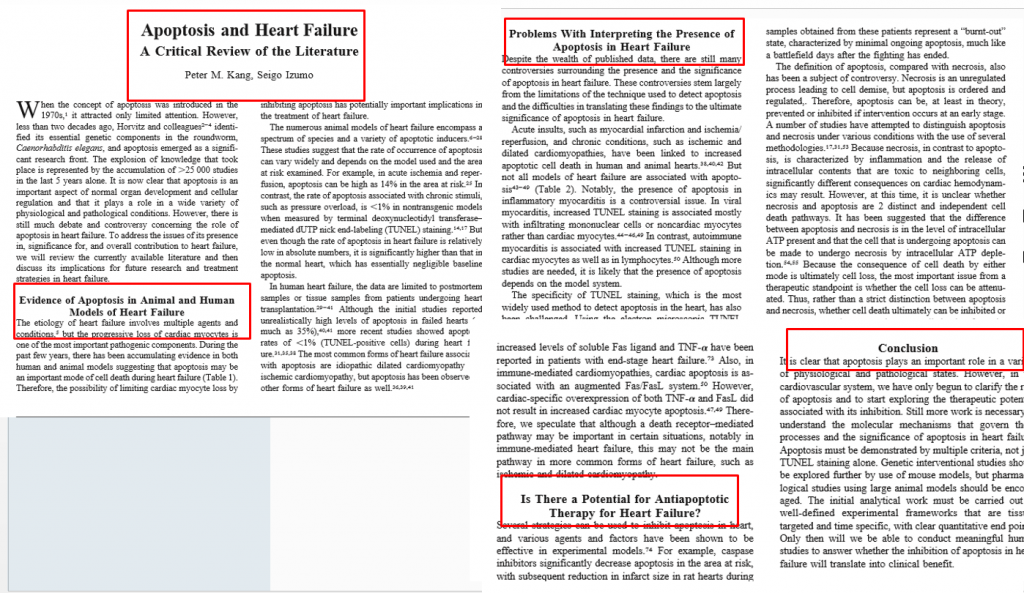
The literature review published as a stand-solitary article presents and analyzes as many of the important publications in an surface area of report equally possible to provide background information and context for a current area of research or a study. Stand-alone reviews are an excellent resource for researchers when they are first searching for the most relevant data on an area of study.
Such literature reviews are generally a bit broader in scope and can extend farther back in time. This means that sometimes a scientific literature review tin can be highly theoretical, in addition to focusing on specific methods and outcomes of previous studies. In add-on, all sections of such a "review commodity" refer to existing literature rather than describing the results of the authors' own study.
In addition, this blazon of literature review is usually much longer than the literature review introducing a study. At the end of the review follows a decision that once once more explicitly ties all of the cited works together to show how this assay is itself a contribution to the literature. While non absolutely necessary, such articles often include the terms "Literature Review" or "Review of the Literature" in the title. Whether or not that is necessary or appropriate can also depend on the specific author instructions of the target journal. Have a look at this commodity for more than input on how to compile a stand-lonely review commodity that is insightful and helpful for other researchers in your field.
Writing a Literature Review in 6 Steps
And then how do authors plough a network of articles into a coherent review of relevant literature?
Writing a literature review is not usually a linear process—authors often get dorsum and cheque the literature while reformulating their ideas or making adjustments to their written report. Sometimes new findings are published before a study is completed and need to exist incorporated into the current work. This also means you will not be writing the literature review at any one time, only constantly working on it before, during, and after your study is complete.
Here are some steps that will aid you begin and follow through on your literature review.
Step ane: Choose a topic to write about—focus on and explore this topic.
Cull a topic that you are familiar with and highly interested in analyzing; a topic your intended readers and researchers will discover interesting and useful; and a topic that is current, well-established in the field, and about which at that place has been sufficient research conducted for a review. This will help you lot find the "sweet spot" for what to focus on.
Step 2: Research and collect all the scholarly information on the topic that might be pertinent to your study.
This includes scholarly articles, books, conventions, conferences, dissertations and theses—these and any other academic work related to your area of study is called "the literature."
Step 3: Clarify the network of information that extends or responds to the major works in your area; select the textile that is most useful.
Employ thought maps and charts to place intersections in the research and to outline of import categories; select the material that will be most useful to y'all review.
Step 4: Describe and summarize each article—provide the essential information of the article that pertains to your study.
Determine 2-3 of import concepts (depending on the length of your article) that are discussed in the literature; take notes near all of the important aspects of this report relevant to your topic being reviewed.
For example, in a given study, perhaps some of the master concepts are X, Y, and Z. Note these concepts so write a brief summary about how the commodity incorporates them. In reviews that introduce a study, these can be relatively brusk. In stand-alone reviews, at that place may be significantly more texts and more concepts.
Step v: Demonstrate how these concepts in the literature chronicle to what you discovered in your study or how the literature connects the concepts or topics being discussed.
In a literature review intro for an article, this data might include a summary of the results or methods of previous studies that correspond and/or confirm to those sections in your own study. For a stand-alone literature review, this may hateful highlighting the concepts in each article and showing how they strengthen a hypothesis or show a design.
Discuss unaddressed issues in previous studies. These studies that are missing something you address are important to include in your literature review. In addition, those works whose theories and conclusions direct support your findings will exist valuable to review hither.
Pace half-dozen: Identify relationships in the literature and develop and connect your own ideas to them.
This is substantially the same equally footstep v, but focused on the connections between the literature and the current written report or guiding concepts or arguments of the newspaper, not only on the connections between the works themselves.
Your hypothesis, statement, or guiding concept is the "aureate thread" that will ultimately tie the works together and provide readers with specific insights they didn't have earlier reading your literature review. Make sure you know where to put the research question, hypothesis, or statement of the problem in your enquiry paper so that yous guide your readers logically and naturally from your introduction of before work and prove to the conclusions you want them to draw from the bigger motion picture.
Your review will not only cover publications on your topics just volition include your own ideas and contributions. By following these steps you will be telling the specific story that sets the groundwork and shows the significance of your research and y'all can turn a network of related works into a focused review of the literature.
In addition to these guidelines, authors too need to check which style guidelines to use (APA, AMA, MLA, etc.) and what specific rules the target periodical might take for how to structure such manufactures or how many studies to include—such information can normally be found on the journals' "Guide for Authors" pages.
Finally, later on you take finished drafting your literature review, exist sure to receive proofreading and language editing for your academic piece of work. A competent proofreader who understands academic writing conventions and the specific style guides used by academic journals will ensure that your paper is ready for publication in your target journal.
Wordvice Resource
If you demand more advice on how many references to include in your newspaper, how to write the abstract or title for your manuscript, or how to impress the editor of your target journal with a perfect cover letter, and then head over to the Wordvice academic resource website.
Source: https://blog.wordvice.com/how-to-write-a-literature-review/
0 Response to "Where in Journal Articles Does a Literature Review Typically Appear?"
Post a Comment